Big jump in wages, we catch up with Slovakia
EnglishWages in November saw a significant jump in Hungary not only from figures from the previous year but also from the previous month. Although there are seasonal factors behind this growth, these numbers already appear much more favourable in a regional comparison than a month before.
Monthly differences
When we looked into earnings in the previous month, we pointed out that the current earnings were in line with regular earnings, i.e. they did not contain any special benefits. To some extent, the situation has been the same year after year:
in certain months there is a jump in earnings due to non-regular benefits, while in other months they fall back because of the lack of them.
The strongest months are usually November and December, as well as March and April.
10 percent jump
This trend proved to be particularly strong in 2020, presumably as an effect of the economic situation. The Central Statistical Office also stressed in their statement that average earnings were largely determined by the increase in non-regular earnings (bonuses, gratuities). While figures in October were essentially the same as in previous months, November brought a huge jump.
Average gross earnings of full-time employees stood at 438 thousand forints, while the same figure was 350 thousand without public employees.
The average of January-November, which was practically the same as the October data, was only 399 thousand and 410 thousand forints, respectively, so a jump of nearly 10 percent took place in November.
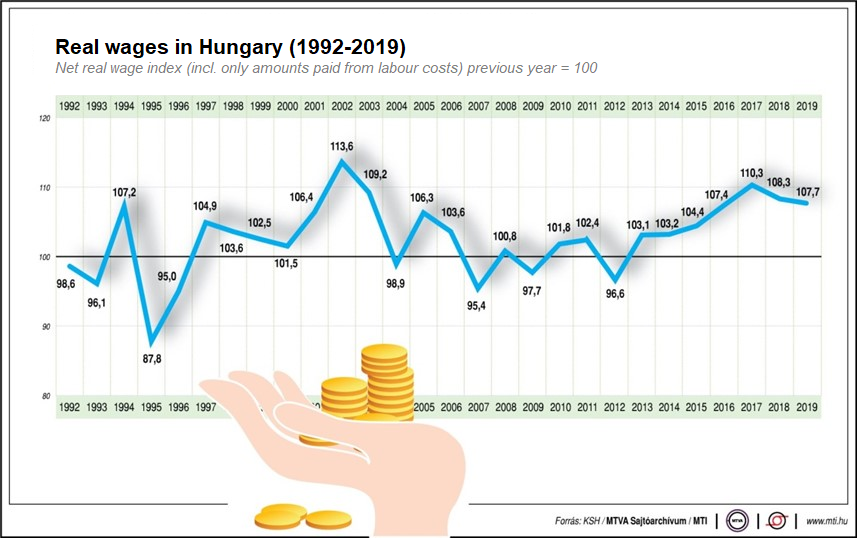
Decent amount also in euros
Average net earnings stood at 291 thousand forints, or 300 thousand including family tax allowances. If we exclude public employees, we get 298 and 307 thousand forints, respectively.
These are spectacular numbers, as they had not even come close to 300 thousand forints before; and now the amount is fairly high even in euros: the 307 thousand forints at the current exchange rate equals 860 euros.
We had reached the 800 euro level before the pandemic, but we fell back below 800 due to the weakening of the forint. Now, however, we are well above that, while only the Czech Republic saw a substantial wage increase of 5% year-on-year in the region, and there the strengthening of the Czech koruna also increased the amount in euros. Let us see how the current numbers compare to regional data.
Regional comparison
With the big jump in November, we reached the level of Slovakia for the first time in a while, and essentially also that of Poland, which has got an edge on us lately although we had been on the same level for a long time. We also closed in on Latvia, while Lithuania, with its miraculous economic performance last year is still ahead of us with average net earnings of 930 euros.
In the Visegrád region, however, only the Czech Republic is ahead of us with over 1,000 euros now, so
for the first time in a while we are not lagging behind within the group.
It is interesting to note that if the exchange rate of the forint were at 310-315 against the euro, which had been the case for years, we would now be approaching the level of 1000 euros, overtaking Poland and Slovakia.
According to a more realistic calculation, however, there is a chance that a substantial correction will take place when the economy returns to a growth path, as last year's weakening of the forint during the epidemic seemed a bit excessive. At an exchange rate of 340 forints per euro, the current figure would be 900 euros.
Closing in
As for the comparison with the target countries: we reached 34 percent of the German level of 2530 euros, i.e slightly exceeded one third of it;
however, if we take into account the 2200 euro level of France, Belgium, the Netherlands and the United Kingdom, our figures already reach 39 percent, which seems quite encouraging, as it is generally assumed that labour migration slows down or even stops if half the wage level in a given country is reached.
Looking ahead
Finally, it’s worth looking at what we can expect in the future. If wage growth continued to be around 10 percent, we could continue closing the gap dynamically, although currently this is not a realistic scenario because of the crisis. The decisive question is
whether the pace of wage growth can pick up again when all restrictions are lifted at the end of the pandemic, and
all branches of the economy reopen and start growing again.